
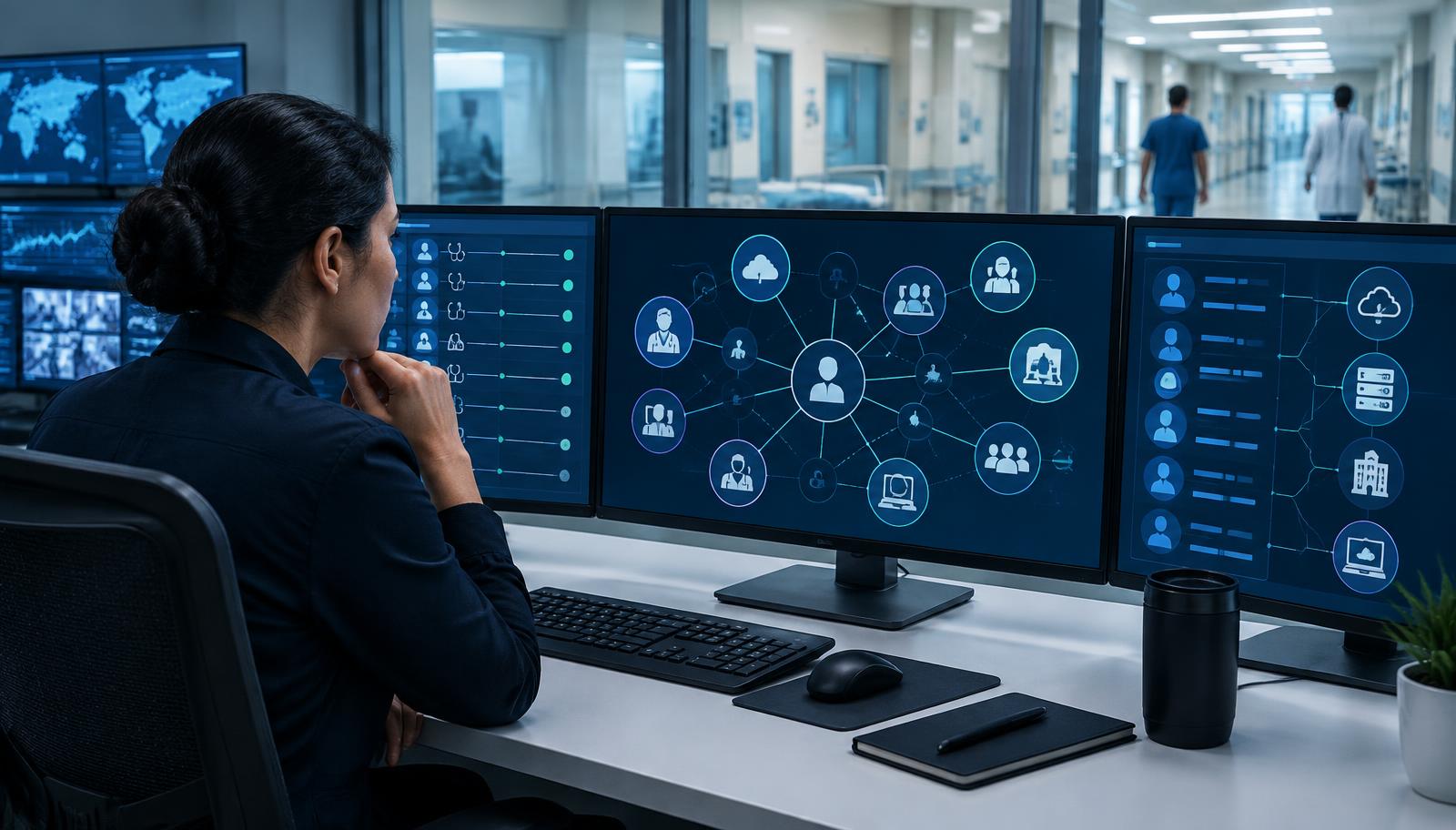
Hospital identity risk extends across clinicians, contractors, vendors, service accounts, and cloud systems. CTI can show defenders which accounts and access paths deserve attention first.
In a hospital, identity is not a single directory and access is not limited to employees.
Physicians may work across affiliated facilities. Traveling clinicians need rapid onboarding. Vendors support imaging, laboratory, pharmacy, and building systems. Shared workstations support urgent care. Service accounts connect applications that cannot simply be turned off. Cloud platforms and remote support tools extend the identity boundary beyond the campus.
Attackers understand this complexity. They do not need to defeat every control. They need one trusted identity with a useful path to a valuable system.
Identity threat intelligence helps hospitals stop treating every account alert as equal. It connects adversary behavior, exposed credentials, local privileges, and clinical dependencies so teams can focus on the access paths most likely to cause harm.
Start with the identities that cross boundaries
The most important identity inventory is not a list of usernames. It is a map of trust.
Identify accounts that can move between:
- Corporate IT and clinical environments
- A vendor network and hospital systems
- Cloud administration and on-premises infrastructure
- One hospital and another facility in the same health system
- Routine user access and privileged administration
- Patient-facing applications and back-office services
These boundary-crossing identities deserve stronger monitoring because compromise can create disproportionate reach.
Turn external reporting into identity hypotheses
Threat reporting becomes useful when it produces a testable question. If current reporting shows actors using help desk impersonation, stolen browser sessions, remote management tools, or valid credentials, analysts should ask:
- Which help desk workflows could be abused to reset a privileged account?
- Which roles can register a new authentication factor?
- Where are session tokens accepted without device checks?
- Which vendors can initiate remote sessions?
- Which service accounts permit interactive login?
- Are disabled clinicians, contractors, or vendor users still represented in downstream systems?
HHS identifies social engineering as a major health sector threat and describes how fraudulent support messages can capture credentials used to access financial and patient data (HHS Health Industry Cybersecurity Practices). CTI should convert that broad warning into local collection and detection requirements.
Add context to credential exposure
A leaked credential is not automatically an incident, but it should not be handled as a flat list either. Enrich the finding with:
- Whether the identity still exists
- Whether the password has changed since exposure
- Authentication methods available to the account
- Privileges and group memberships
- Recent login geography and device history
- Access to clinical, research, billing, or infrastructure systems
- Evidence that the credential has been validated or traded
A credential tied to a dormant public portal has a different priority than one tied to remote administration of a clinical system. Both should be addressed, but the response sequence should reflect potential impact.
Monitor the path after authentication
Valid-account activity often looks less suspicious than malware. Detection should focus on changes in behavior and combinations of events:
- First-time access to a sensitive application
- New authentication factor followed by privilege use
- Vendor login outside an approved service window
- Rapid access across unrelated systems
- A service account used from a workstation
- Successful login after repeated help desk interactions
- New mailbox rules followed by financial or patient-data access
These patterns are stronger when analysts know which techniques are active in the healthcare threat environment.
Include clinical operations in containment plans
Disabling an identity may interrupt care, device support, pharmacy operations, or laboratory interfaces. That does not mean the account should remain active. It means response planning must identify safe alternatives before an incident.
For each high-impact identity, document:
- The business or clinical service it enables
- A backup owner
- A safe disablement or credential rotation procedure
- Dependencies that may fail
- A break-glass option with monitoring
- The communication path to clinical leadership
This turns containment from an improvised technical action into a rehearsed operational decision.
Measure reduced exposure, not alert volume
Useful identity intelligence should lead to fewer unmanaged vendor accounts, shorter time to revoke stale access, stronger monitoring of privileged paths, and faster containment of compromised users.
Hospitals cannot eliminate identity complexity. They can make that complexity visible. Once defenders understand which identities cross the most important boundaries, CTI can help them watch the paths attackers are most likely to take.