
Actor Tracking & Notebooks
Auto-built profiles for the adversaries that matter, seeded from the MITRE ATT&CK group catalog and refreshed continuously.
Learn more18 sensors. IT to grid.
ThreatSpire now impersonates real OT gear — Modicon PLCs, SIPROTEC relays, SIMATIC I/O, and power-grid personas — so attackers reveal intent before they touch production.
Built natively on the MITRE ATT&CK® framework
The problem
Reports are scattered across vendors and channels. Claims are made without sources. Findings rarely reach the people who decide what to hunt, block, or escalate — and by the time they do, the next campaign is already moving.
"Threatspire has saved me over 60% in time researching threats to our organization"
Carl Doss, CTO — The Joselyn Foundation
The platform
Auto-built profiles for the adversaries that matter, seeded from the MITRE ATT&CK group catalog and refreshed continuously.
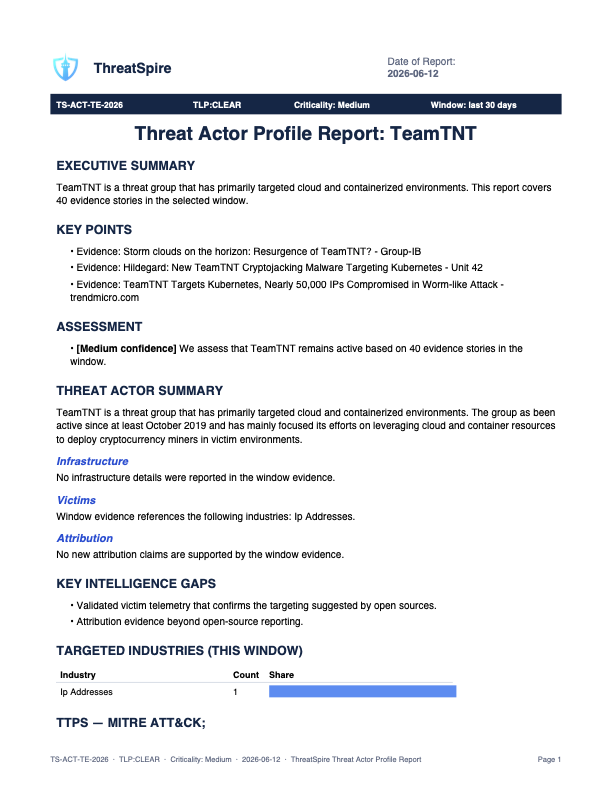
Learn moreOne-click, CTID-style Threat Actor Profile Reports — executive summary, confidence-rated assessments, MITRE TTP tables, and evidence with clickable sources, drafted by AI and grounded in citations.
Charts that show who an actor is hitting and how — industries derived by AI from the evidence itself, techniques sourced from MITRE ATT&CK group data.
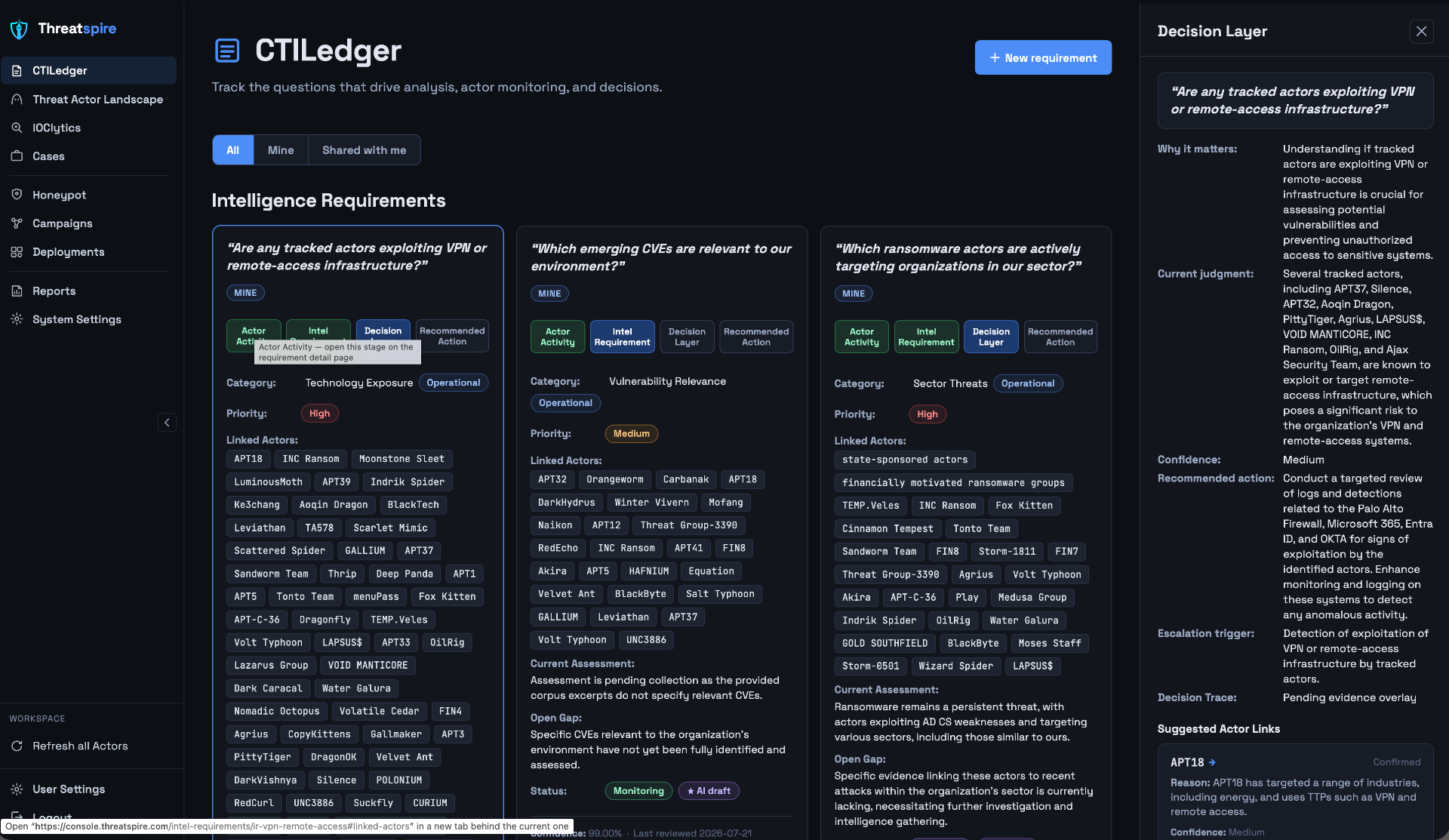
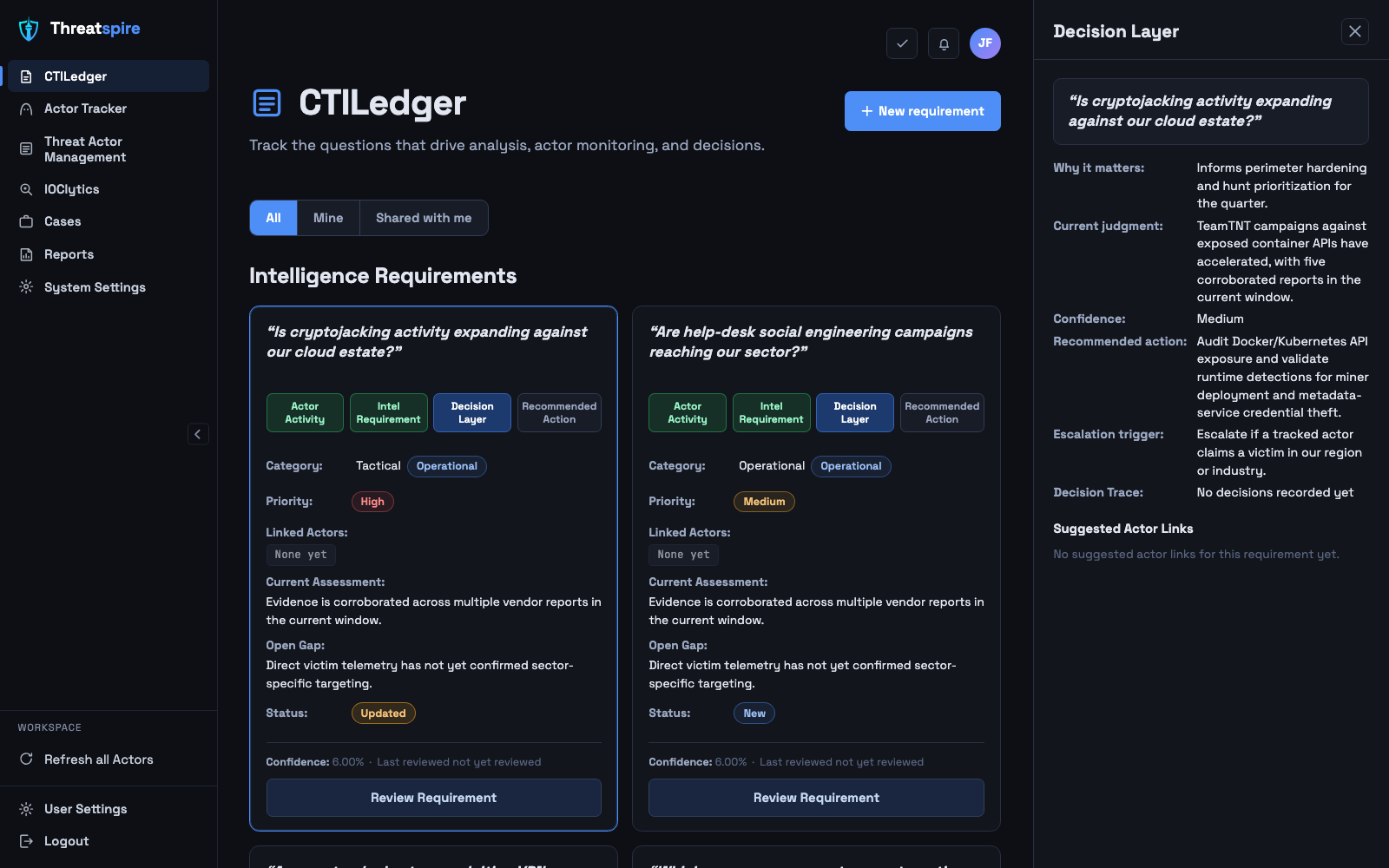
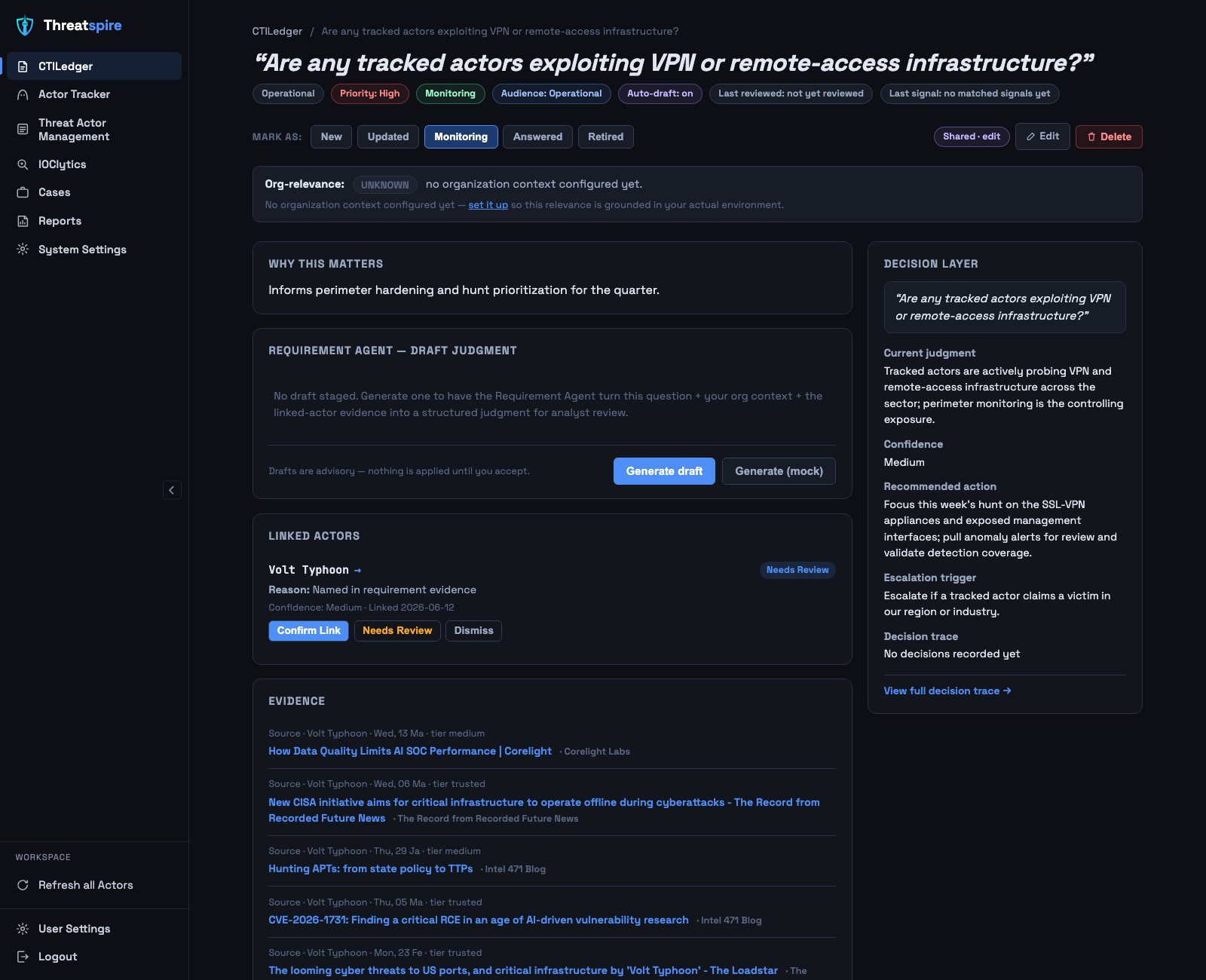
Turn your org's standing questions into tracked, signal-driven RFIs. The Requirement Agent drafts judgments and recommended actions for analyst review.
Learn moreEvery analyst gets their own workspace. Share requirements, cases, and IOCs at view, comment, or edit level — with comment threads and a full admin audit log.
Eighteen protocol sensors from IT to the plant floor: SSH, Telnet, HTTP/HTTPS, RDP, SMB, SIP/VoIP, MySQL, MSSQL, Redis, LDAPv3/AD, DNP3, Modbus/TCP, IEC 60870-5-104, IEC 61850 MMS, PROFINET, BACnet/IP, OPC-UA, and generic TCP/UDP.
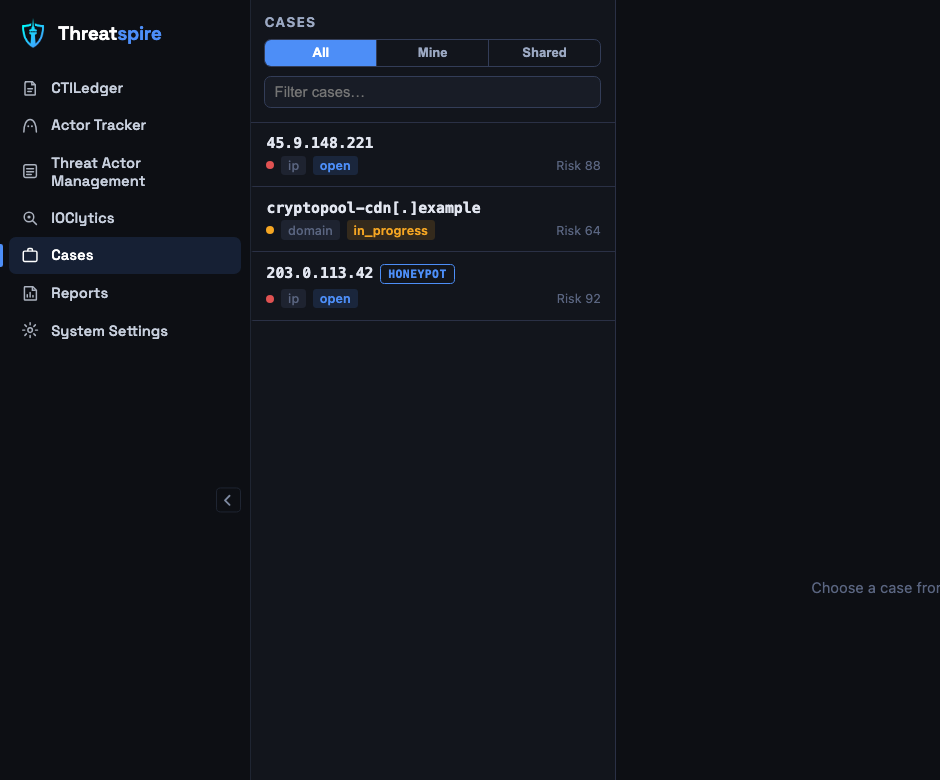
Validate, enrich, and manage indicator lifecycle. Investigations become shareable cases with Diamond Model analysis.
Learn moreSSO, MFA, role-based access, and strict per-tenant isolation built in from day one.
AI agents sweep dark web markets, forums, and leak sites around the clock for your leaked credentials, exposed intellectual property, and brand mentions, then triage every hit for analyst review.
New · Announcing
ThreatSpire now deploys AI agents that sweep dark web markets, forums, paste sites, stealer-log channels, and ransomware leak sites around the clock. Every hit is triaged, correlated to your organization, and routed into the console with evidence and recommended next actions. No feeds to tune, no queries to write. The agents do the digging; your analysts make the call.
Specialized agents each run their own collection plan, then hand off verified findings the same way a junior analyst would. You review the evidence, not the raw chatter.
Combolists, stealer logs, and breach dumps tied to your domains, screened and validated before they reach you.
Source code, schematics, and internal documents offered for sale or posted to leak sites and paste dumps.
Lookalike domains, fake support channels, and fraudulent social profiles impersonating your people.
Leak-site listings and forum chatter naming your organization, mapped to the actors behind it.
New · Announcing
Eight fully-simulated clinical devices. Real protocols. Zero real patient data. Every captured attack flows straight into your ThreatSpire threat intelligence pipeline — built on ThreatSpire, not bolted onto it.
Healthcare is the most targeted critical-infrastructure sector on the internet — and the devices attackers go after aren't laptops, they're the ones keeping patients alive. Dialysis machines, infusion pumps, anesthesia systems, and medication cabinets increasingly run on the same networks as everything else, often with decades-old protocols and little to no authentication. Most security teams have no way to see an attack against one of these devices coming until it's already happened.
Hospital Honeypot puts a decoy in front of the attacker instead — and feeds everything it captures directly into ThreatSpire, so it becomes part of your actual threat picture, not an isolated log file nobody checks.
Kidney dialysis machine, MRI scanner, bedside cardiac monitor, medication dispensing cabinet, point-of-care analyzer, infusion pump, anesthesia machine, and nurse call system — covering diagnostics, life support, medication management, and clinical communications.
DICOM for the MRI sensor, HL7 v2 over MLLP for the cardiac monitor, a POCT1-A2-inspired protocol for the point-of-care analyzer, an IEEE 11073 SDC-inspired protocol for anesthesia — attackers interacting with these sensors see the same protocol behavior they'd see on a real device, down to vendor-specific personas and realistic drifting vitals.
Every captured interaction — a status query, a brute-forced login, a parameter write, a connection scan — is automatically classified against MITRE ATT&CK for ICS, so what you get isn't raw logs, it's structured, analyst-ready signal.
Hospital Honeypot is a ThreatSpire product — it requires an active ThreatSpire subscription to run. Every event is pushed directly into your ThreatSpire tenant for actor attribution, IOC extraction, and alerting alongside the rest of your threat intel, with no separate console to check and no manual export step.
Every patient name, session, and device identity is synthetically generated at runtime. Nothing real ever touches the codebase, the database, or an attacker's screen.
Signed, notarized installers for macOS, plus .deb and .rpm packages for Linux. Install the binary, point it at your ThreatSpire tenant with your API token, and it's live.
Decoy personas
A generic ICS responder gives itself away the moment an attacker fingerprints it. Ask a real Modbus PLC who it is and it answers with a vendor and a model number. ThreatSpire's industrial sensors answer the same way — down to the identification objects operators actually query — so reconnaissance returns a plausible device instead of a tell.
Pick the persona that matches the plant you're defending. Changes are applied to your on-prem honeypot within about 30 seconds — no redeploy, no site visit, no SSH session.
The rest of the industrial sensors ship with fixed decoy identities modelled on equipment you'd actually find on a plant floor or in a substation.
Every sensor is capture-only. The decoys answer, log, and attribute — they never execute anything and never reach back into your network.
Evidence to leadership
How it works
Pull in reporting, vendor feeds, and internal signal.
Map activity to actors and MITRE ATT&CK techniques.
Surface priority questions and decision traces.
Hand analysts evidence-backed answers.
Built for teams
Why ThreatSpire
No unsourced claims. Every assertion in ThreatSpire links back to the report, feed, or telemetry it came from.
Not bolted on. Actors, techniques, and detections share one shared vocabulary from the ground up.
Drafts, gists, and report narratives generated with Amazon Bedrock stay grounded in cited sources — never hallucinated, always reviewable.
See ThreatSpire on your own actors and requirements.
Live · Deception Grid
Attacks logged
Unique adversaries
Countries of origin
Sensors live
Credentials captured
updated continuously