
Creating Priority Intelligence Requirements is only half the battle. The other half is managing them over time: tracking progress, reviewing relevance, and knowing when to retire a requirement that has served its purpose or outlived its usefulness.
Most CTI programs treat Priority Intelligence Requirements (PIRs) as a one time exercise. The team runs a workshop, drafts a list, posts them on a wiki, and moves on. Six months later no one remembers which PIRs are active, which have been answered, and which quietly became irrelevant after the last reorg.
That is not a requirements problem. It is a management problem. PIRs are living artifacts. They need a defined lifecycle, regular reviews, clear ownership, and an honest retirement process. Without those, even the best written requirements decay into shelfware while analysts chase whatever feels urgent that week.
This post walks through how to manage PIRs after they are written: the lifecycle stages, the metrics that matter, the review cadence that keeps them honest, and the discipline of retiring requirements that no longer serve the business.
Why PIR Management Matters
When PIRs are not actively managed, three failure patterns emerge.
Zombie PIRs stay on the list long after the decision they supported has been made or the threat they tracked has dissolved. Analysts continue producing reports against them out of habit. Leadership stops reading. The work continues but the value evaporates.
Orphaned PIRs have no clear owner on either side. No analyst is responsible for collection. No stakeholder is waiting for the answer. The PIR exists in the document but not in anyone's calendar or queue.
Scope creeping PIRs start narrow and grow until they cover everything and nothing. A PIR originally written as "What ransomware groups are actively targeting our sector in EMEA?" quietly becomes "Tell us about ransomware." The collection plan can no longer be tuned because the question has no edges.
All three patterns are symptoms of the same root cause. Nobody is actively managing the requirement after it was created.
The PIR Lifecycle
A PIR is a contract between the intelligence function and the decision maker. Like any contract it has a beginning, an active period, periods of review, and an end. Treat the lifecycle as explicit stages rather than a vague "open" or "closed" status.
Stage 1: Draft
The PIR has been proposed but not yet validated with the stakeholder. The draft phase is where you confirm three things. First, the decision the PIR supports actually exists and is owned by someone. Second, the question is answerable with reasonable collection effort. Third, the answer will change behavior. If any of those fail, the PIR should not move out of draft.
Draft PIRs do not generate collection work. They are reviewed in the next requirements cycle and either promoted to active or rejected with a documented reason.
Stage 2: Active
The PIR has been approved. Collection is happening against it. Analysts are producing finished intelligence keyed to the PIR. The active stage is where most of the work lives and where most of the management mistakes happen.
Active PIRs need an owning analyst, a stakeholder, a collection plan, and a defined cadence for delivery. They should also have a target review date set when they enter the active stage. Without a forced review date, active PIRs drift into the zombie category.
Stage 3: Blocked
The PIR is approved but cannot be progressed. The most common reasons are missing collection access, missing tooling, an unfilled analyst role, or a stakeholder who is unavailable to receive intelligence. Blocked is a legitimate stage. What is not legitimate is leaving a PIR in blocked status indefinitely without action.
Every blocked PIR needs a blocker description, a named owner of the blocker, and a target date for resolution. If the blocker cannot be resolved within a reasonable window, the PIR should be retired rather than left in limbo.
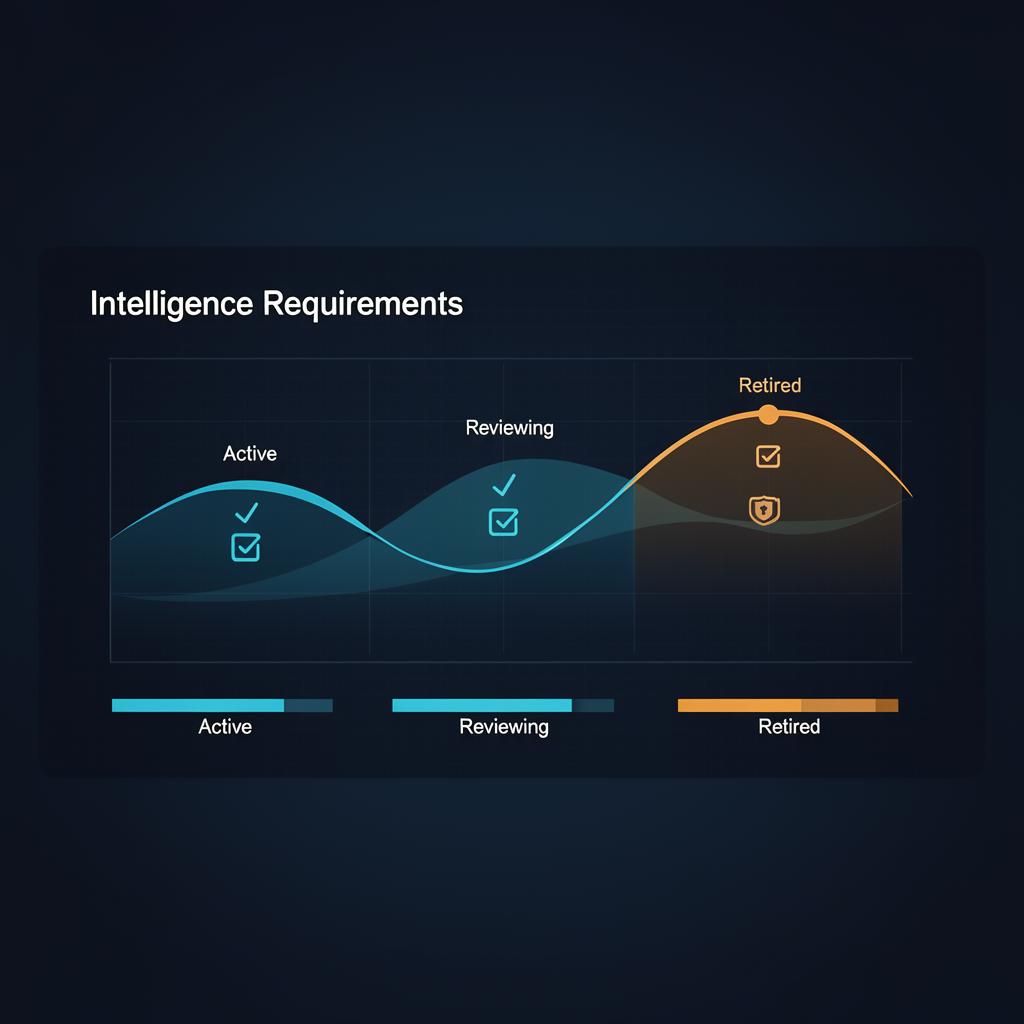
Stage 4: Reviewing
The PIR has hit a scheduled review point. The team is actively assessing whether it should continue, change, or be retired. Reviewing is a short lived stage. A PIR should not sit in review for more than one cycle.
Stage 5: Closed
The PIR has been answered. The decision it supported has been made. The intelligence product is delivered. Closed differs from retired in that the PIR served its purpose and was completed. It is the success state.
Closed PIRs are valuable in their own right. They become reference material for similar future requirements and they are the evidence base for demonstrating program value.
Stage 6: Retired
The PIR is no longer relevant. The threat has changed, the business priority has shifted, the decision is no longer being made, or the question can never be answered with available collection. Retired PIRs are documented with a reason and archived. They are not deleted.
Retirement is not failure. A PIR that gets retired after honest review is healthier than a PIR that quietly continues consuming analyst hours without producing value.
Metrics That Actually Matter
You cannot manage what you do not measure, but you can drown a program in metrics that no one acts on. Pick a small set focused on operational health and quality.
Operational Metrics
Active PIR count by stakeholder, by business unit, by threat category. If one stakeholder owns thirty active PIRs and another owns two, the imbalance is worth a conversation.
Average PIR age in the active stage. A rising average without rising closure rates is a sign that PIRs are being added without being completed or retired.
Time in blocked status. Any PIR blocked for more than one review cycle should appear on an escalation list.
Coverage rate. What percentage of finished intelligence products map back to an active PIR? A low rate suggests analysts are working off ad hoc tasking rather than the requirements list. A 100 percent rate may suggest the requirements list is being retrofitted to match the work.
Quality Metrics
Stakeholder satisfaction captured through a short structured review at each scheduled check in. Not a survey. A conversation with two or three questions: Is this PIR still tied to a decision you are making? Are the products useful in their current form? What is missing?
Decision impact documented per closed PIR. What decision did this intelligence inform? What changed because of it? If you cannot answer those questions, the PIR was not really a PIR.
Forecast accuracy for PIRs that involve prediction. Track what you said would happen and what actually happened. Calibration matters more than being right.
Review Cadence
Reviews are where management actually happens. Without a scheduled cadence, PIRs drift. Three review types cover most needs.
Weekly: Operational Triage
Short, internal to the CTI team. Review the active PIR list. Flag anything stuck, anything overdue, anything where collection is not producing. Triage blockers. Update statuses. This is not a deep review. It is housekeeping.
Monthly: Stakeholder Check In
For each major stakeholder, a thirty minute conversation per month covering their active PIRs. Are they still aligned with the decisions you are making? Are the products useful? What is changing in your environment that should reshape the requirements?
Do not skip this even when nothing has changed. The act of asking surfaces drift that the stakeholder would not have raised unprompted.
Quarterly: Full PIR Review
A working session that walks the entire PIR list. Promote drafts. Retire stale items. Re-scope items that have crept. Confirm ownership and cadence for everything that stays active. The quarterly review is where the PIR portfolio gets actively shaped rather than passively accumulated.
Set a fixed agenda. Without one, the review becomes a status update meeting and the management work does not happen.
When to Retire a PIR
Retirement decisions are the hardest part of PIR management because they feel like admitting failure. They are not. Retire a PIR when any of the following is true.
The decision the PIR supported has been made and is not being revisited.
The threat the PIR tracked no longer maps to your environment. The actor stopped operating. The vulnerability was patched globally. The campaign concluded.
The stakeholder who owned the PIR has changed roles and the new owner does not see the requirement as a priority.
Collection has been attempted in good faith for two or more cycles and the PIR cannot be answered with available sources. Document this honestly. A PIR that cannot be answered is a collection gap, and the gap belongs on a different list.
The PIR has been answered to the satisfaction of the stakeholder and no follow up question has emerged.
When you retire a PIR, write down why. The retirement record is part of the evidence base for the program. It also protects analysts from being asked six months later why the team stopped covering a topic.
Tools and Templates
Heavyweight requirements management platforms are usually overkill for a CTI team. A simple structured table works, whether it lives in a ticketing system, a wiki, or a spreadsheet. Each PIR row needs at minimum: identifier, title, stage, owner, stakeholder, decision supported, collection plan reference, last reviewed date, next review date, and retirement reason if applicable.
The platform matters less than the discipline of keeping it current. A pristine spreadsheet that is updated weekly outperforms a sophisticated platform that no one looks at.
Common Mistakes
Confusing volume with value. Twenty active PIRs is not better than ten. The right number is the number your team can actually collect against and report on with rigor.
Treating retirement as a defeat. Retiring a PIR is a sign of a healthy program. It means someone is paying attention.
Letting the PIR list become a wish list. Every active PIR represents a commitment of analyst time. If the list grows without anything being retired, the commitments are being made implicitly and the team will burn out.
Reviewing without deciding. Reviews that produce no status changes, re-scoping, or retirements are not reviews. They are meetings.
Skipping the stakeholder conversation. PIRs cannot be managed from inside the CTI team alone. The stakeholder owns half of the contract.
Closing Thought
Writing good PIRs is a craft. Managing them over time is an operating discipline. The teams that get the most value from their requirements are the ones that treat the PIR list as a living portfolio rather than a static document.
Build the lifecycle. Schedule the reviews. Track the small set of metrics that change behavior. Retire what no longer serves the business. The PIRs that survive will be the ones that actually drive decisions, and that is the whole point.
Document retired PIRs with lessons learned. They are the memory of the intelligence program.
If your CTI team is writing excellent PIRs but struggling to show consistent value, the problem may not be the requirements. It may be that no one is managing them after they are written.